thank you, that would be the perfect answer but the access is restricted: from the website is reported
Extramural Investigators must be permanent employees of their institution at a level equivalent to a tenure-track professor or senior scientist with responsibilities that most likely include laboratory administration and oversight. Laboratory staff and trainees such as graduate students and postdoctoral fellows are not permitted to submit project requests.
the problem is, I am not a permanent employee, just a postdoc
• 1 views
•
link
What are you actually looking for? What is your objective with this dataset, if it exists?
I suppose you could take any reasonably good dataset and apply some filters to get that "perfect" dataset.
That said, the colours in fastqc are just indications and do not determine conclusively if a dataset is appropriate for a biological question.
I just need a didactical dataset that shows how fastqc works, but all the datasets I have available show some defect of some sort. I still haven't found one that does not have any flag raised. I need to produce a figure like that one sees in the manual, but without a good dataset, I cannot. I could trim, but in that case, it would not be an original set...
I even got a dataset reported from a manual (I won't say which one) and the base quality figure is as good as in the book; what they did not show was the associated summary: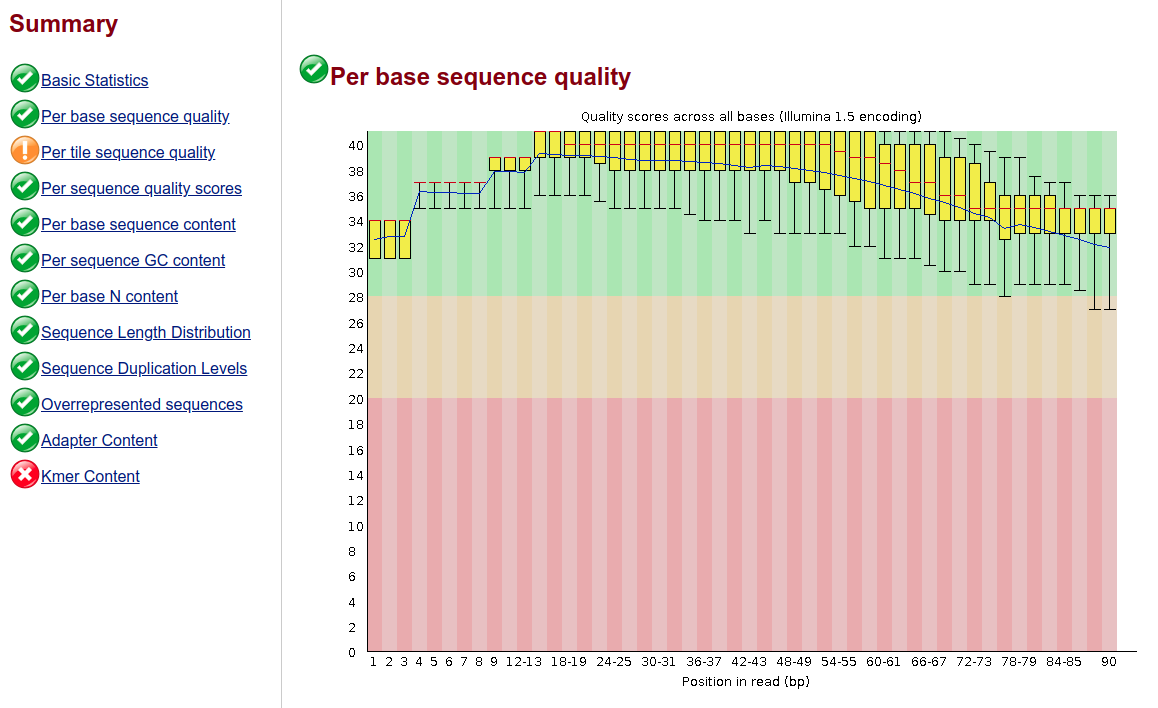
also, this was an exome analysis, not WGS...
I'm not even sure what would be required to have every single fastqc flag pass. I've never seen a green tick for Kmer content.
FastQC has a file called
limits.txtthat you will find in theconfigurationfolder in FastQC distribution. If the redX'sbother you that much feel free to edit and change the intervals in this file (that throw those red X warnings) so everything becomes green.As others have said there are no perfect datasets. It is important to keep the context of the experiment in mind as you look at FastQC results. Use the results as a guide to decide if you should do anything additional to the data (e.g. trim, normalize etc) or just proceed with your usual analysis workflow. You will know a really bad dataset (that you should discard) when you find it.