Hi everyone,
I have a question on basic statistics. I feel really bad about asking this but I'm having a brain freeze now. So, I'm going back to basics.
Purpose: Calculate expected trinucleotide frequencies specific to 5'UTR regions only, which will be used to check whether some windows (around 20bp long) at particular locations (such as beginning or end) in a set of specific 5'UTRs have different amount of these trinucleotides by calculating observed-to-expected ratio.
Calculated Data: I collected all 5'UTR sequences and counted all nucleotides. I have calculated their frequency as follows:

where  ,
,  ,
,  ,
,  represents occurrence count of each nucleotide in all 5'UTR regions (these regions only!) and
  represents total amount of nucleotides in all 5'UTR regions.
From this I calculate expected frequency of a trinucleotide by

where  . Then, for each window of interest, I count the occurrence of each
  trinucleotide and calculate observed frequency by
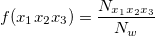
where  represents the occurrence of trinucleotide and
  represents the window size.
Lastly, observed-to-expected ratio becomes

So, I feel like I'm thinking something extremely wrong in this basic thing and I should take window size in the expected frequency calculation as well. But I couldn't be able to convince myself to do this since I already get a "frequency" on the observed part as well.
Am I doing something really wrong and misinterpreting/overthinking everything now?
EDIT: I uploaded a couple of images to a more compatible website but decided it wasn't worth the effort - Ram.
genome
analysis
statistics