This is a really neat solution!
• 0 views
•
link
When analyzing clinical genomes, I often find it hard to visualize the genomic context of a potential driver mutation (say a point mutation on a key cancer gene). For example, is there simultaneous LOH/amplification at the mutation locus? How many copies of the mutant allele are there? Did the mutation arrive before/after the overlapping copy number change? Is there a structural variation breakpoint near by? Are there other point mutations close by?
Thus, I wonder if there is a plotting tool that visualizes a local range of the genome (e.g. a window big enough to inspect a gene) that integrates (in one plot):
Note that the purpose is more to infer the consequence of a mutation as opposed to validating whether the mutation is real or not, which we can already do with a variety tools such as samtools tview.
Circos is a nice format that integrates all three classes of mutations, but it is more for global scale inspections and does not provide enough resolution to zoom into specific gene regions in order to answer the above questions about key mutations of interest. Another close one is IGV, but it does not incorporate allelic specific copy number info.
Thanks!
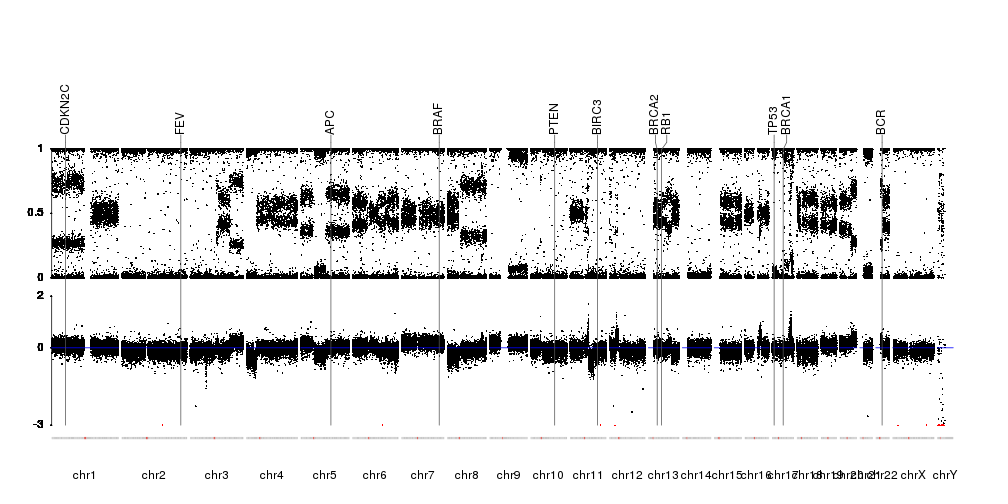
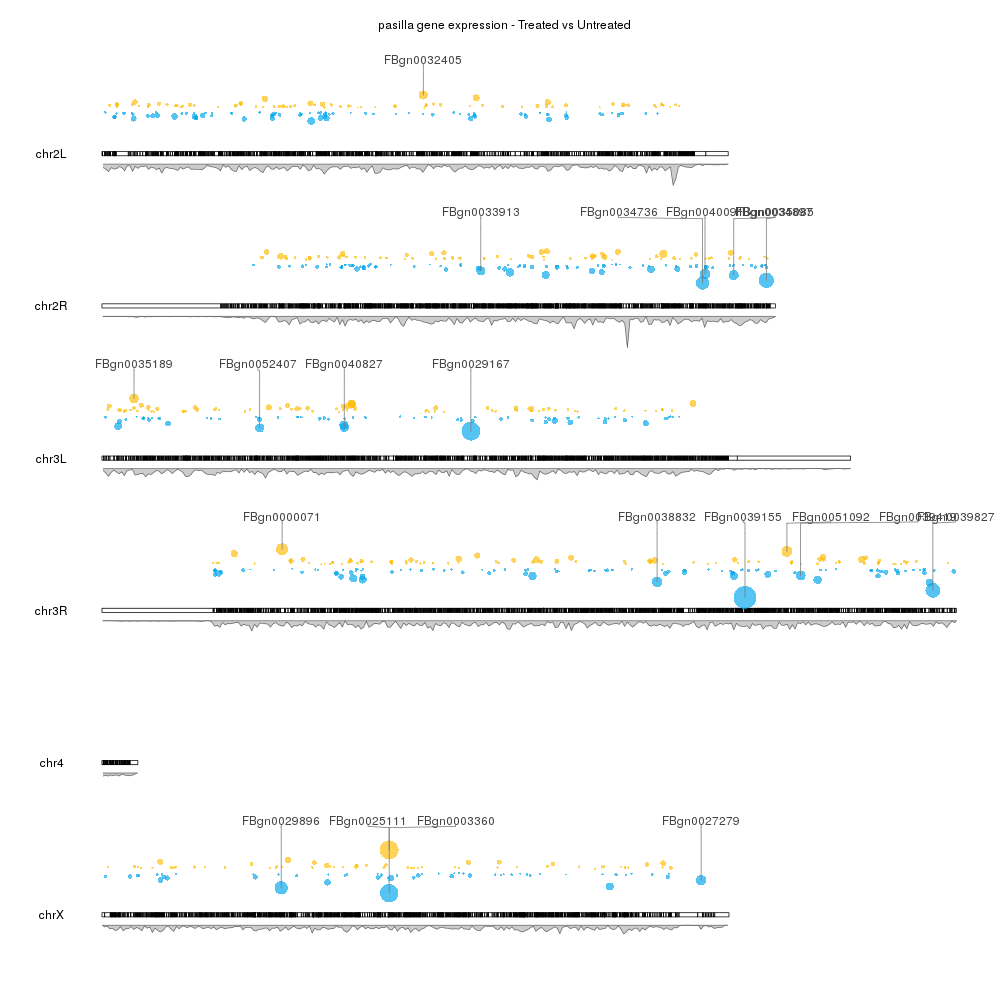
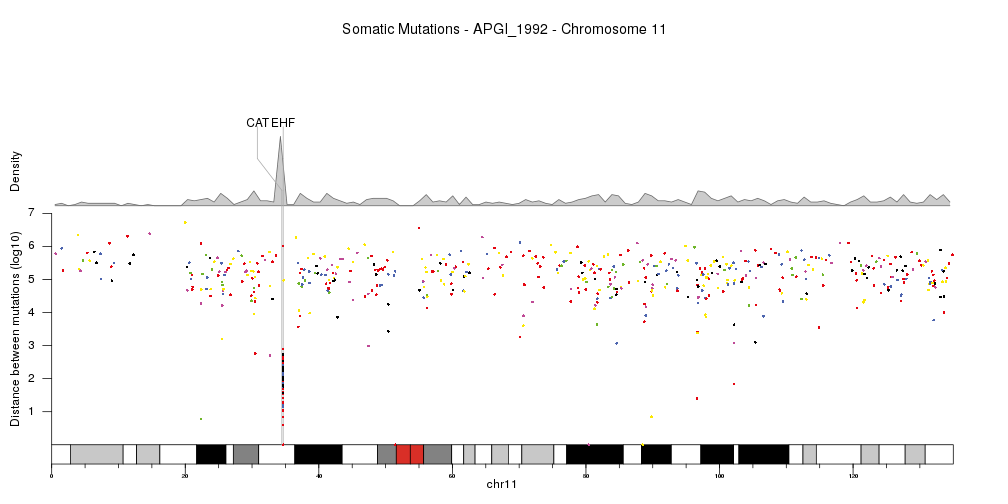
You can give a try to karyoploteR. It's an R package to plot data on genomes and can go from single base to the whole genome. Take a look at the tutorial and examples to see what it looks like. It's only a plotting tool and does not know much biology, so it can plot almost anything as long as you have it precomputed and can map it to any of the available plot types. Right now it does not have the possibility of plotting individual sequencing reads from a BAM file, if you need that.
A couple of examples of whole genome views.
Note: Setting zoom to a small genomic region in the call to plotKaryotype will created a zoomed in version of the plots with the exact same code.
This is a really neat solution!
Point mutations in the region
try IGV http://software.broadinstitute.org/software/igv/
I wrote
udpdated my bam2raster to support multiple bams. https://t.co/2PaWUFggg7 pic.twitter.com/VJxlj5Bz8A
— Pierre Lindenbaum (@yokofakun) May 10, 2017
playing with my java version of samtools/tview pic.twitter.com/LJbODfaupB
— Pierre Lindenbaum (@yokofakun) April 29, 2017
The local copy numbers (major/minor allele if available)
http://lindenb.github.io/jvarkit/WesCnvSvg.html
singleton HET CNV found with delly2 . pic.twitter.com/mSHcfASST2
— Pierre Lindenbaum (@yokofakun) October 31, 2018
http://lindenb.github.io/jvarkit/WesCnvTView.html
a first screenshot: pic.twitter.com/1qUkcZ80Df
— Pierre Lindenbaum (@yokofakun) October 19, 2018
SVs affecting the region
http://lindenb.github.io/jvarkit/SvToSVG.html
my tool sv2svg can also display multiple regions at the same time. Here is a translocation ; the curves are the links between the discordant pairs. https://t.co/GIhtFqf1kB pic.twitter.com/r4WcnqhD7A
— Pierre Lindenbaum (@yokofakun) November 16, 2018
Thanks, but I'm more looking for a visualization that shows all three kinds of alterations in one plot, so that it's possible to put everything in context and infer the consequence/evolutionary history of a point mutation (e.g. allelic dosage, timing of the point mutation with respect to the copy number change at the locus)
Log in to answer this question.