Thank you Delaney, these links answered many questions of mine.
• 0 views
•
link
I am trying to do exactly the same pipeline for RNA-seq data process as the TCGA does. Usually when we ask a sequencing service, we can get a fastQ file. It contains sequence and read quality information. The alignment step comes next. However in the case of TCGA, as their pipeline suggested (https://docs.gdc.cancer.gov/Data/Bioinformatics_Pipelines/Expression_mRNA_Pipeline/). It seems that they used BAM files as one of the inputs. I was wondering why they used BAM files as inputs and how can I repeat what they did? In addition, why isn't there seem to be a adaptor trimming process?
1: 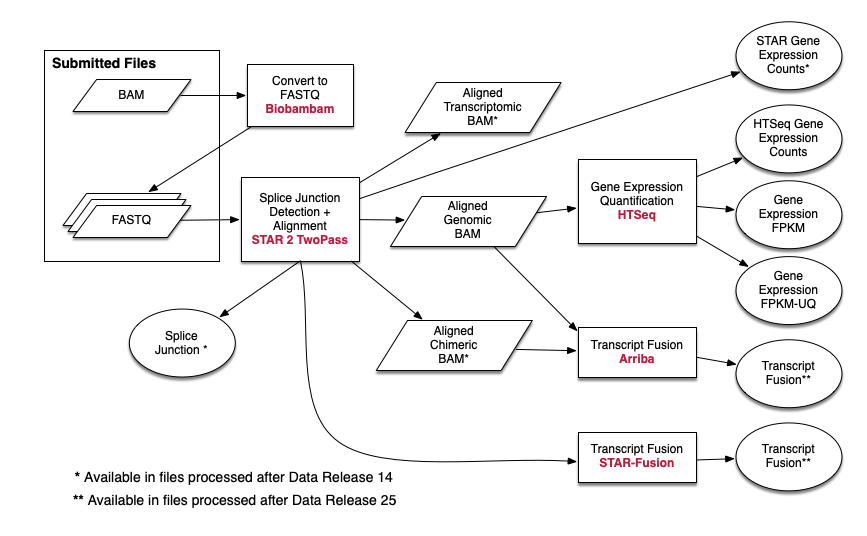 https://docs.gdc.cancer.gov/Data/Bioinformatics_Pipelines/Expression_mRNA_Pipeline/
https://gdc.cancer.gov/about-gdc/gdc-faqs - Read the answer to "How can I access GDC sequencing data in FASTQ format?"
Level 1 (aka the raw fastq) data is restricted; to request access to it, see instructions here: https://gdc.cancer.gov/access-data/obtaining-access-controlled-data
Adaptor trimming is unnecessary in RNA-seq read mapping; many papers have been written about it (e.g. https://academic.oup.com/nargab/article/2/3/lqaa068/5901066 ).
Thank you Delaney, these links answered many questions of mine.
For your curiosity of why GDC sometimes uses BAM as input? Because GDC is not a sequencing center. GDC only does analysis on data that data submitters provided. If data submitters only provide BAMs, GDC has no choice but to use BAMs.
Log in to answer this question.