I'm a little surprised that Retraction Watch are essentially calling for an anything-goes comment policy. PubMed is not YouTube.
• 225 views
•
link
via Pedro Beltrao:
The new Pubmed commenting system http://t.co/ZNmZAL8JYY @PubMedCommons
— Pedro Beltrao (@pedrobeltrao) October 22, 2013
\tweet 392668221993529345
http://www.ncbi.nlm.nih.gov/pubmedcommons/
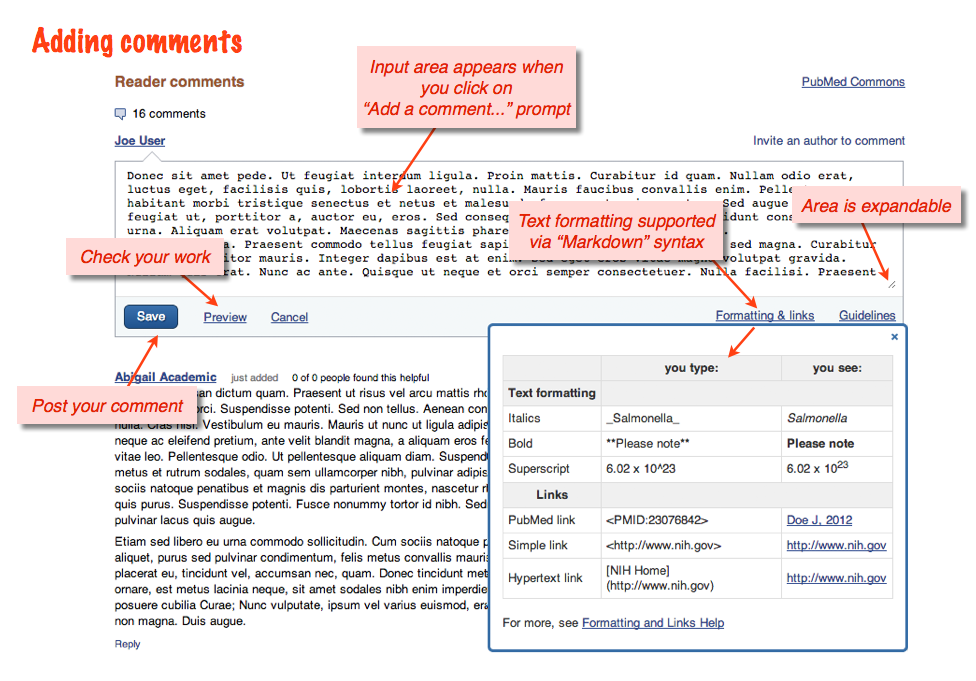
PubMed Commons is a system that enables researchers to share their opinions about scientific publications. Researchers can comment on any publication indexed by PubMed, and read the comments of others. PubMed Commons is a forum for open and constructive criticism and discussion of scientific issues. It will thrive with high quality interchange from the scientific community. PubMed Commons is currently in a closed pilot testing phase, which means that only invited participants can add and view comments in PubMed.
Update:
And there is a new field for Entrez: via
http://www.ncbi.nlm.nih.gov/m/pubmed/?term=has_user_comments[sb]
Here is my first comment in PubmedCommons for my article \pmid 9682060: "My code has moved to github"

You should also see the discussion at Retraction Watch about this:
EDIT (after trying it out): I commented on the Biostar paper to kick the tires. I wondered what would happen if you invited an author--I thought that might be interesting to try and potentially useful (also a spam risk). But you have to know the author's email apparently.

I'm a little surprised that Retraction Watch are essentially calling for an anything-goes comment policy. PubMed is not YouTube.
People have found this post helpful: Joining PubMed Commons: A Step-by-step Guide. If you want an invite and have a PubMed article I'm happy to try to give you an invite. Need one of your Pubmed IDs + the email for your MyNCBI account and I will do that invite as shown in the graphic here. That seemed to work for someone I invited.
Are they importing comments from other sources? The comments on the DESeq paper dates from June: http://www.ncbi.nlm.nih.gov/pubmed/20979621/
Log in to answer this question.