I thought multi-mapping reads was about a read which is mapping at multiple locations. But here my read map at ONE position. But this position is corresponding to multiple transcripts.
I use RSEM to count abundance of each transcript after alignment with STAR and featureCounts to count abundance of each transcript after alignment with Bowtie.
My question is, if a read map on a given location of the genome, but at this location, there are multiple transcripts overlapping : How RSEM or featureCounts decide which transcript is it ?
For example, in the mouse at this location : https://www.ensembl.org/Mus_musculus/Location/View?r=7:44804176-44853021;db=core;g=ENSMUSG00000074141
You can see il4i1 and nup62 are overlapping.
But in my counts table, I have a big difference between abundances of those 2 genes. Why ?
3 answers
Mapping to the transcriptome will result in a high rate of reads mapping to multiple locations, due to the multiple isoforms present in a transcriptome. RSEM will use an expectation-maximization to optimally assign (fractional) counts from multi-mapping reads, while featureCounts will, with default settings, discard all multi-mapping reads.
The same applies to reads assigned to overlapping features: featureCounts discards them, RSEM tries to optimally assign the counts.
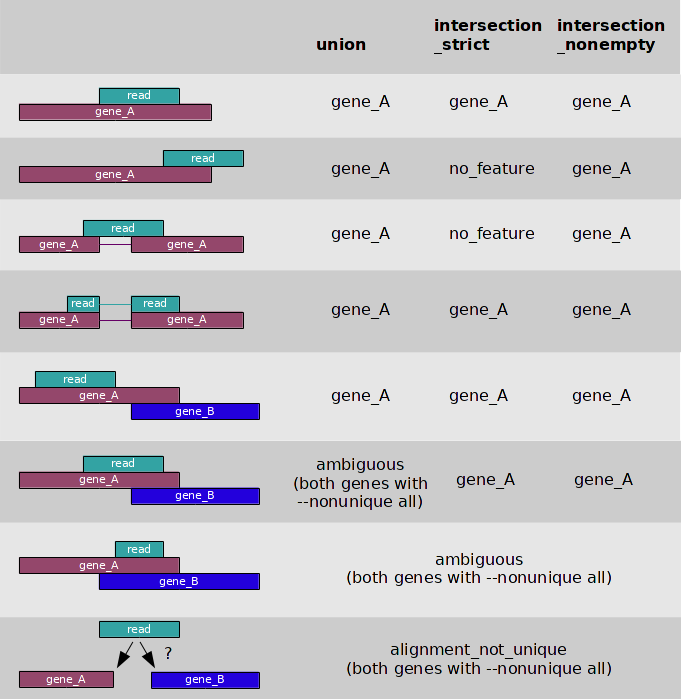
For overlapping genes, featureCounts is similar to HTSeq-count, which has a nice graph showing you the various options:

I think that because Featurecounts is not smart about reads whose assignment is ambiguous, it is not suitable for assessing transcript abundance. Genes would be okay, exons would be okay, but not transcripts.
Log in to answer this question.