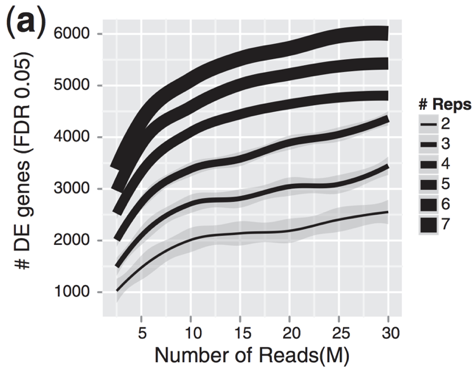
The link was an example. I have seen other papers say a good rule-of-thumb is ~10 million reads.
Here is some more info regarding our experimental design: The samples are total RNA, and I believe were ribo-depleted. We have 2 groups/condition (drugged vs. non-drugged), non-drugged as 3 replicate and drugged has 9 replicates. The samples are patient-derived-xenografts from human cancer. The sequenced reads deriving from mouse have been filtered out. From the reads left, we generally get only ~3 percent aligning to exonic regions, from a total of around ~80-90 million reads. My question is, are we good to look at DEGs?
• 0 views
•
link
I normally expect between 1/3 and 2/3 of reads sequenced to fall into exonic regions (depending on many thing, but primarily if the sample is total RNA or polyA RNA). There is something weird about a sample where only 3/80 million reads map to exons.
Also, I'd say 10-20 million reads is a bit on the low side.