Seems so obvious now. Thanks!
• 0 views
•
link
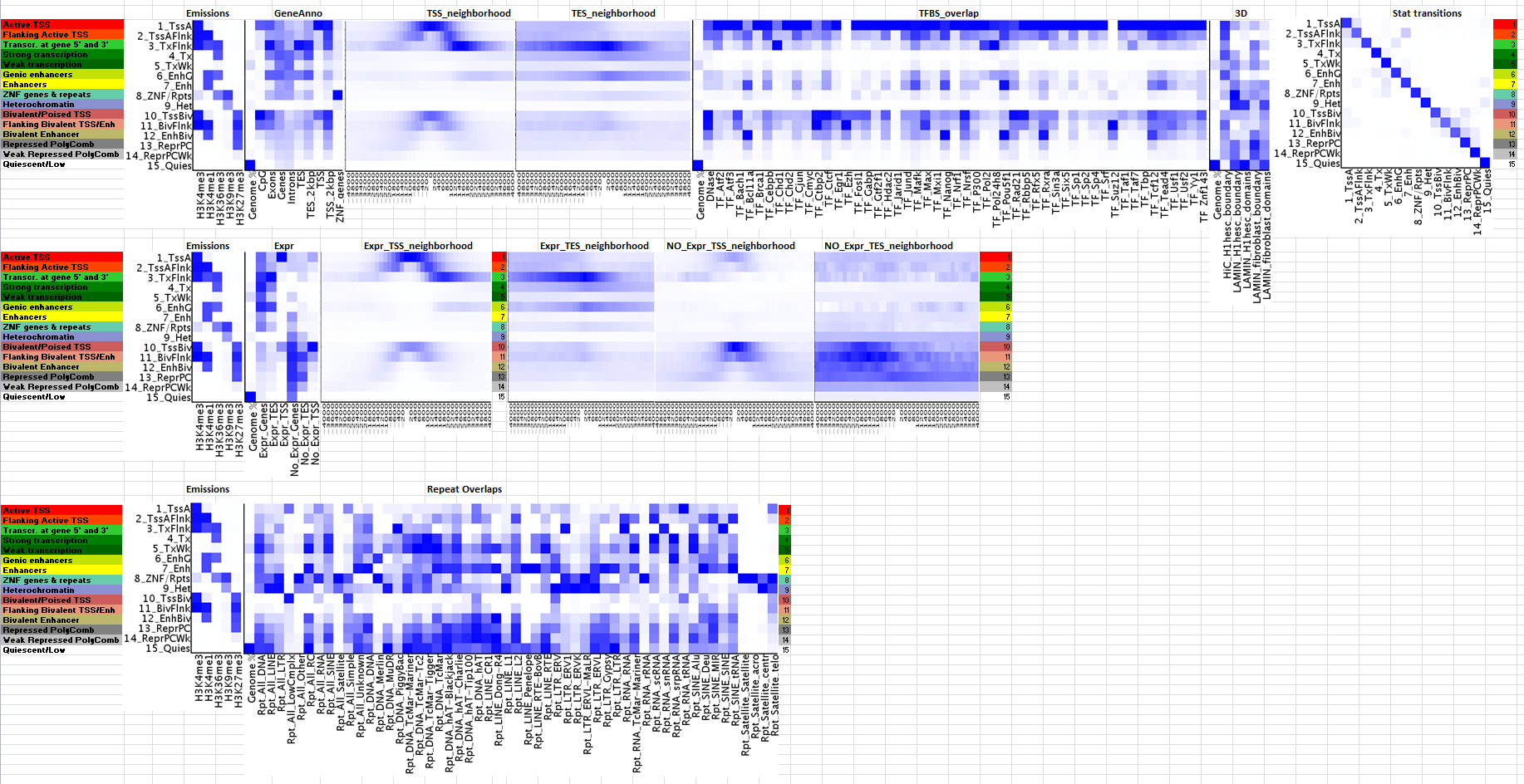
I'm working with the ChromHMM predictions in 127 consolidated epigenomes. I'm wondering where can I find biological descriptions for the 15 core states?
For example what's the difference between a Genic Enhancer and an Enhancer?
I assume the Genic Enhancer directly contacts a promoter (then what's the difference with an Enhancer)
I can't seem to find the needed documentation.
http://egg2.wustl.edu/roadmap/web_portal/chr_state_learning.html
If you look at the "GeneAnno" plot (ie genomic region annotations), "genic enhancers" occur more frequently in gene bodies, and occur in exons, while "enhancers" (state 7) occur less frequently in gene bodies and almost never in exons. Both seem to occur in introns with equal frequency. If you dig into the raw data, you can also see that the "genic enhancers" occur at TSS about twice as frequently. Also, the "genic enhancers" occur about 26 times less frequently genome-wide.
It's important to note that these are probabilistic categories based solely on the histone marks -- there are probably some promoters/TSS mixed in with the regions annotated as genic enhancers. Conversely, many of the genic enhancers may be located intergenically. Lastly, there is no guarantee that any of the regions annotated as enhancers actually function as such. If they do function as enhancers, then they must, by necessity, be brought into proximity to promoters via enhancer-promoter looping. This mechanism functions regardless of whether they are genic or intergenic.
Seems so obvious now. Thanks!
Can we generate consensus plots from multiple samples of each subtype using Chromhmm?
Log in to answer this question.
Hey.. I am in search of same answer. Did you figure it out somehow?