I do not know how much biological background you have so I answer a bit more extensively:
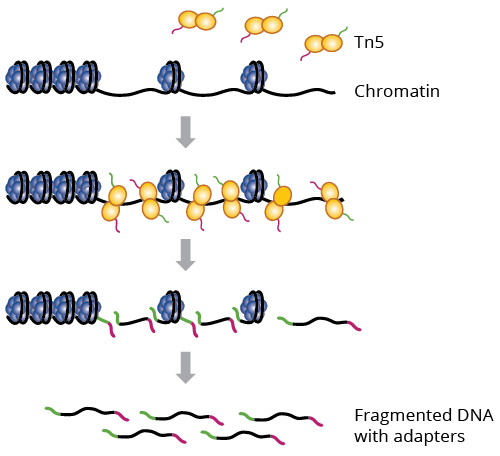
The Tn5 is the workhorse of ATAC-seq. This enzyme is added to the native chromatin and will insert an Illumina adapter to the DNA at sites that are not protected by nucleosomes while simultaneously fragmentating the DNA. DNA in open chromatin is therefore adapter-tagged and can be enriched over the background of closed chromatin using PCR followed by quantification via NGS.
The accumulation of Tn5 insertion sites is therefore a measure of chromatin accessability. From the technical site, given you have the Tn5 insertion positions (=the 5' end of each read) you can use standard peak callers to identify local enrichments (=peaks). One typically extends the Tn5 sites by like 50bp in each direction to smoothen the signal and allow more precise identification of peak summits.
The count matrix is then simply created by intersecting peak locations and Tn5 sites (or reads which is basically the same).
So yes peak height is a function of Tn5 insertion frequency (which is the same as read counts).
Hope this was clear, if not feel free to ask.