Hi,
I actually run featureCounts myself. if you are aware could you provide a simple code to convert featurecounts to FPKM.
thanq
• 1 views
•
link
I have a dataframe with featureCounts like following:
Geneid         sample1  sample2 sample3 sample4
ENSG00000241860.6   16  65  19  56
ENSG00000237491.8   57  53  36  89
ENSG00000177757.2   9   6   4   5
ENSG00000228794.8   1145    528 418 355
ENSG00000225880.5   38  21  37  80
ENSG00000230368.2   9   10  6   8
ENSG00000272438.1   36  8   1   26
ENSG00000230699.2   70  24  22  35
ENSG00000241180.1   0   0   1   2
ENSG00000223764.2   272 35  32  61
ENSG00000272512.1   6   16  239 46
ENSG00000224969.1   0   4   7   14
ENSG00000242590.1   669 401 2673    1425
ENSG00000273443.1   122 8   16  6
ENSG00000223823.1   11  0   5   7
ENSG00000272141.1   42  48  47  279
I see that in GDC portal TCGA htseq-counts are converted to FPKM with this formulae HT-seq FPKM. I wanted to convert the above featureCounts to FPKM. How to do that?
PS: FPKM is not for Differential analysis
Thank you.
Try countToFPKM package. This package provides an easy to use function to convert the read count matrix into FPKM values normalised by library size and feature effective length. Implements the following equation:
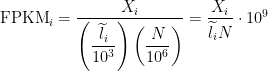
The fpkm() function requires three inputs to return FPKM as numeric matrix normalized by library size and feature length:
you have many ways to solve this problem ,example :DESeq2 or other R packages, in addition,you can write a script to solve this problem,here,i give my script to convert reads count to FPKM
def cal_FPKM(stringtie_count_file,ref,outpath):#stringtie_count_file euqal to featureCounts result file
count_matrix=numpy.loadtxt(open(stringtie_count_file,"rb"),dtype=str,delimiter=",",skiprows=0)
head=count_matrix[0,:].tolist()
count_matrix=numpy.delete(count_matrix, 0, axis=0)

genes=count_matrix[:,0].tolist()
count_matrix=numpy.delete(count_matrix, 0, axis=1)

count_matrix=count_matrix.astype(int)
mapp_reads_count=count_matrix.sum(axis=0).tolist()

exon_dict=load_exon(ref)#load exon bed file ,you can prepare this file by R package:GenomicFeatures

fpkm_file=os.path.join(outpath,"FPKM.txt")
fpkm=open(fpkm_file,"w")

fpkm.write("\t".join(head)+"\n")

for x in xrange(len(genes)):
    gene=genes[x]
    exon_len=exon_dict[gene]
    read_count=count_matrix[x,:].tolist()
    temp_fpkm=[round((n[0]*10**6)/((n[1]*exon_len)/1000),4) for n in zip(read_count,mapp_reads_count)]

    fpkm.write(gene+"\t"+"\t".join(map(str,temp_fpkm))+"\n")

fpkm.close()
Did you run featureCounts yourself, or did you download this data? The original featureCounts output include a column with gene lengths, with these gene lengths and the counts, you have all needed to calculate FPKM according to the formula you linked:
FPKM = [RMg * 109 ] / [RMt * L]
RMg: The number of reads mapped to the gene
RMt: The total number of read mapped to protein-coding sequences in the alignment
L: The length of the gene in base pairs
FPKM is a (bad) within sample normalization, so RMt for each sample is just the sum of counts of reads mapping to all genes from that sample.
Hi,
I actually run featureCounts myself. if you are aware could you provide a simple code to convert featurecounts to FPKM.
thanq
Try countToFPKM package.
Log in to answer this question.