Thanks for the reply. Just so I understand: Is + and - defined as the 5'-3' and 3'-5' DNA (genomic) strands, respectively? Is FR (with PE reads) defined as the first-read is the reverse-complement of the annotated gene-orientation? Therefore, FR PE reads may come from + or - strand?
HISAT2 manuals says for:
For paired-end reads, use either FR or RF.
With this option being used, every read alignment will have an XS attribute tag:
'+' means a read belongs to a transcript on '+' strand of genome.
'-' means a read belongs to a transcript on '-' strand of genome.`
Why does it matter whether I specify FR or RF if every read is tagged with an attribute + or -?
---Edit based on current answer---
Follow up Qs:
Is + and - defined as the 5'-3' and 3'-5' DNA (genomic) strands, respectively? Is FR defined as read-1 is the reverse-complement of the annotated gene-orientation? Therefore, FR PE reads may come from the + or - strand?
2 answers
Because there are at least two main methods for the synthesis of cDNA in stranded libraries
the dUTP method preserves the complementary strand
the Illumina method that directly links to the RNA the linkers, preserves the original orientation of the RNA

This is sort of confusing. You need to organize the ideas..
You usually only read the "+" or 5' -> 3' strand of your reference genome in a text file. The "-" strand is usually hidden in that file. This information is important to acknowledge the orientation of your genome, and the direction each gene is transcribed
Now for the dUTP method.. If you carefully analyze the images, you can figure out that the RNA information you retain in the final cDNA corresponds to the "-" or reverse-complement strand.
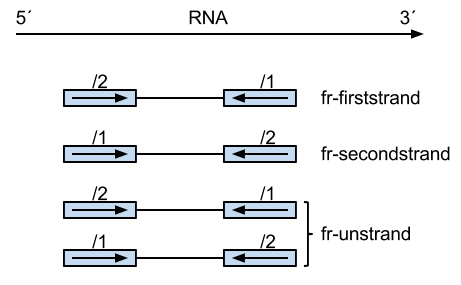
This means that if a first-read read is a reverse-complement of your gene, that gene is orientated in the 5'->3' direction in your reference genome.
This means that the dUTP method corresponds to the fr-firststrand image shown above.
/1 and /2 means first and second reads, respectively
Hope this helps
Log in to answer this question.