looks very cool, I'll definitely look into this.thx
• 0 views
•
link
I don't know if anyone here does research on synteny.
For example, I have a syntenic conversion between human and fish: (human) chr1 20000 40000 (fish) chr10 50000 65000
That means 20000-40000 in human genome chr1 is corresponded to 50000-65000 in fish genome chr10 (maybe relevant functionally or conserved genes).
However, is it possible to know where any PART of 20000-40000 in human genome chr1 (say 20000-30000) can be syntenically mapped to fish genome chr10 (say 50000-60000)?
Thanks
Yes you can absolutely do this.
What you are trying to do is create a lift-over chain. UCSC has this for many species and it a way to compare genomes.
Minimal steps required to generate a lift-over chain
then you can create cool plots that are hard to interpret :-).
Below is a synteny plot I made by following the steps in the link and using circos.
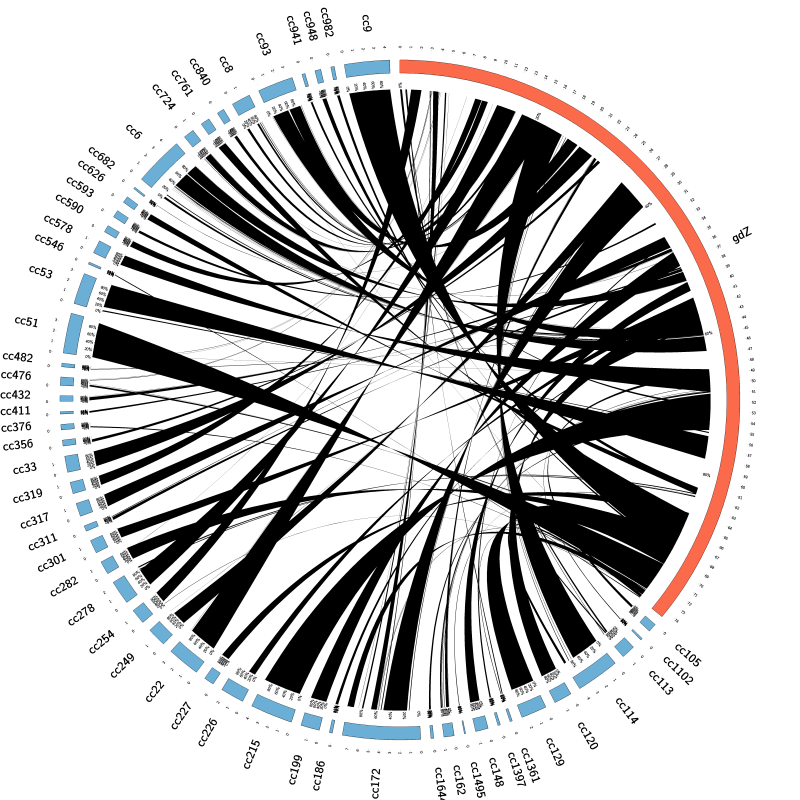
looks very cool, I'll definitely look into this.thx
Given that there are few genes in this region in human (eg, FAM138A and OR4G4P, the latter being a pseudogene), I am not sure you can effectively evaluate such a region of micro-synteny. Synteny is conserved gene order and with such a small number of genes, it will be problematic to do the analysis you'd like. On the other hand, if there are non-gene elements that are conserved between human and fish and these map near FAM138A, you can use these to evaluate the conserved order of the elements, both protein-coding and not.
thx larry, I'm just giving an example. I'm doing whole-genome analysis. My question is, if I wanna do, or can do, how should I carry out such analysis? BY comparing sequence similarity? I can only download such database from online, but don't know how people do it
Log in to answer this question.